

Imagine this scene: Six maintenance workers are simultaneously conducting maintenance on a large conveyor belt. They must lock onto the same power switch. If each of them hangs their own padlock directly onto it – sorry, there is only one lock hole on the switch, which is only large enough to hold one lock. If they all share one lock and have six keys – anyone can unlock it at any time, which is a serious safety violation.
So, how can six people achieve independent physical locking of the same isolation point simultaneously?
The answer is Lockout Hasp – a seemingly insignificant perforated metal plate, but it is the core device in the entire LOTO (Lockout-Tagout) system that enables group locking. It might be the simplest and least noticeable component in the LOTO toolbox, yet it performs the most indispensable function. This article will deeply analyze the definition, working principle, types, application scenarios, and selection criteria of the lock.
1. What is a Lockout Hasp?
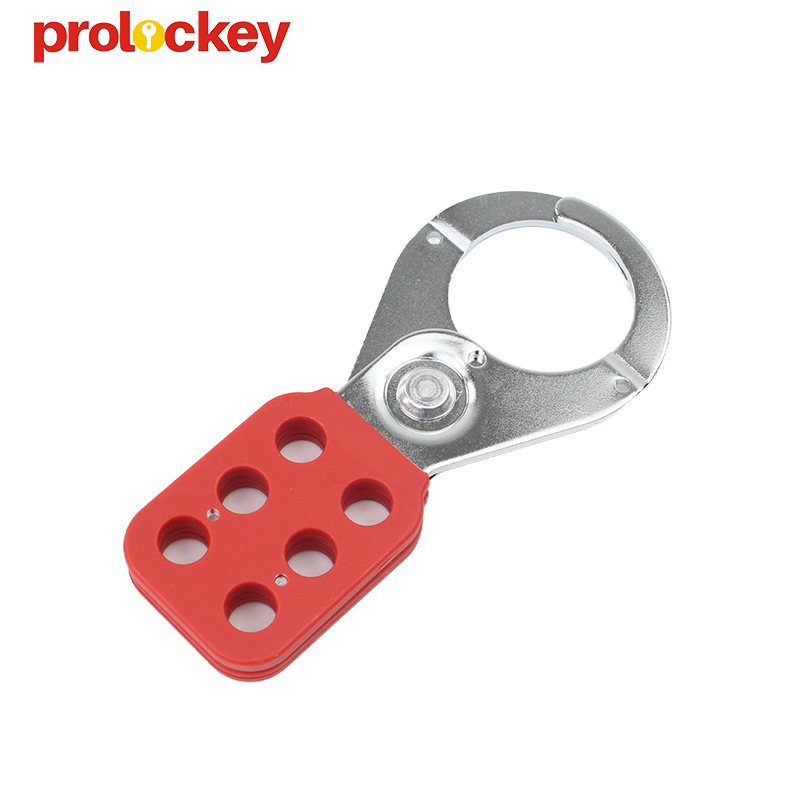
A Lockout Hasp, also known as a multi-hole Lockout Hasp or Safety Lockout Hasp, is a shared Lockout device used in the LOTO procedure. Its appearance is typically a metal or plastic clip with hinges, featuring an active arm on one side and a base plate on the other. When closed, it forms multiple parallel lock holes, allowing multiple workers to insert their safety padlocks through different holes, while locking out the same energy isolation point.
The core mission of Lockout Hasp can be summarized in one sentence: It transforms an isolation point into a secure multi-group locking station.
The structure of the Lockout Hasp appears simple, but its design embodies meticulous safety logic:
Hinge structure: The movable arm can open and close, and when closed, it aligns with the lock holes on the base plate.
Multi-lock hole design: Usually equipped with 4 to 12 lock holes, each hole can pass through the lock bar of a standard safety padlock.
Large opening jaw: The end of the movable arm has a large opening for clamping the operating components of isolation devices such as circuit breaker handles, valve wheels, and disconnect switches.
Sturdy material: Made of steel, aluminum alloy, or engineering nylon, it can withstand the impact and corrosion of industrial environments.
2. Why is Lockout Hasp Needed? – The Safety Dilemma of Group Locking
To understand the value of Lockout Hasp, one must first understand the problem it solves.
Individual Locking vs. Group Locking
In the LOTO (Lockout-Tagout) procedure, “one person, one lock, one key” is the fundamental principle of OSHA 1910.147. When only one worker is responsible for maintaining the equipment, he only needs to directly attach his safety padlock to the isolation device.
Post time: Jul-07-2026


