

Under what circumstances is it appropriate to lock a circuit breaker?
Among various means of electrical isolation, locking a circuit breaker is probably the most frequently used and also the one that is most prone to being misused. Some people think that as long as it is an electrical operation, just locking the circuit breaker in the distribution box is enough; others, on the contrary, believe that the circuit breaker is a “running equipment” and dare not touch or lock it, preferring to only hang a warning sign instead. Both of these ideas are incorrect. A circuit breaker locking is neither a universal key nor a restricted area – it has clear applicable boundaries.
The first appropriate situation: The circuit breaker is the actual isolation point
To determine whether a circuit breaker can be an object for locking, the first fundamental question to ask is: Is it the “necessary passage” for energy?
When the power supply of a device passes through this circuit breaker entirely, and the circuit breaker is tripped, all conductive components downstream are completely disconnected from the power source. Then it is a truly isolation device, locking it is correct. This judgment cannot be guessed; it should be verified according to the electrical drawings and on-site circuits: where does the upstream come from, where does the downstream go, and are there any bypasses in the middle. Old devices with inconsistent drawings and physical objects should be verified publicly, and necessary times, invite electrical professionals to confirm each circuit separately.
In a nutshell: Locking a circuit breaker only becomes valid when it is recognized as the isolation point; any locking before that is just a psychological comfort.
The second appropriate situation: The circuit breaker has the physical conditions for locking and verification
Not all circuit breakers are inherently lockable. For a suitable circuit breaker to be locked, three physical conditions must be met simultaneously.
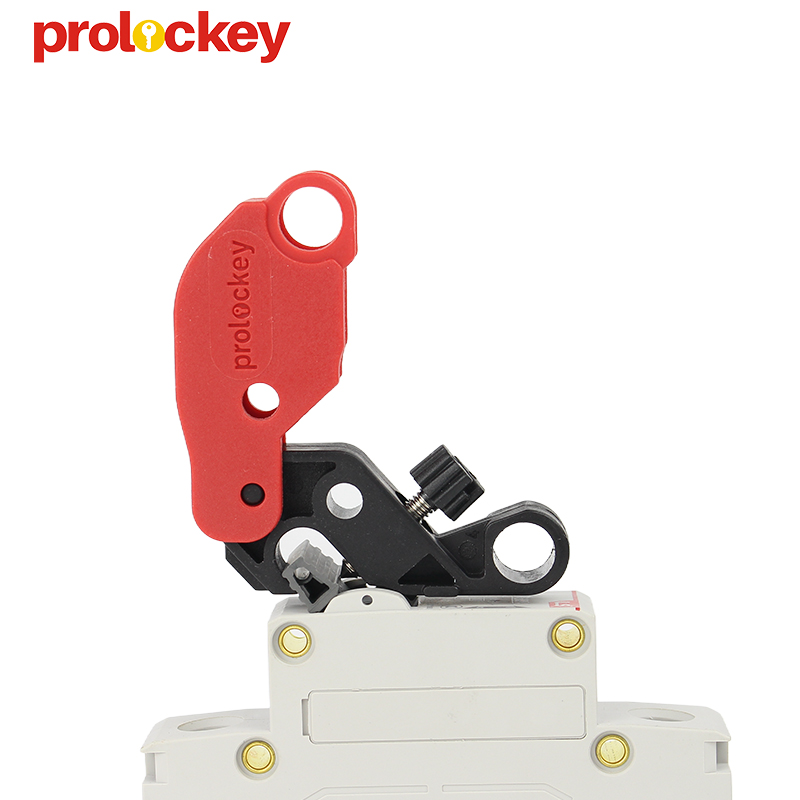
First, the handle can be locked. The circuit breaker locking mechanism must be able to firmly fix the handle in the tripped position, and it should not be possible to move or loosen it with bare hands. Micro circuit breakers and plastic shell circuit breakers have corresponding latch-type locking mechanisms; after installation, the handle must be firmly stuck in the OFF position, with no margin of travel.
Second, the status can be clearly confirmed. Tripping is tripping, closing is closing, the position indication is clear and unambiguous. Some old circuit breakers have blurry handle indications or the possibility of “handle tripping but contacts welding”, in such cases, merely locking the handle is not enough; it is also necessary to combine voltage measurement to confirm.
Third, it can prevent remote tripping. For circuit breakers with electric operation mechanisms and remote control circuits, merely locking the handle may not be enough to prevent a remote button from tripping. In such cases, either the control power supply should be removed first, or a more upstream manual disconnect switch should be chosen as the locking point.
The third appropriate situation: The nature of the operation matches the energy structure
The most typical application of locking a circuit breaker is in “electricity-based maintenance operations” where the circuit breaker is the isolation point. For example, replacing a motor, inspecting the downstream circuits of the distribution cabinet, or maintaining lighting circuits; lock the corresponding circuit breaker, verify the zero voltage, and isolation is complete.
Conversely, there are several situations where locking the circuit breaker alone is not appropriate.
When the equipment has other energy sources – residual pressure in hydraulic accumulators, residual air pressure in pipes, potential energy stored in mechanical springs, and residual charges on capacitors – the circuit breaker only cuts off electricity, but none of the other energies are blocked; each must be found separately and their isolation points and release routes must be identified.
When the circuit breaker is only a part of the control circuit – some circuit breakers control contactor coil circuits rather than the main circuits, locking it, the main circuit remains energized. Such “locking at the wrong level” accidents are not uncommon in maintenance accidents.
When mobile devices connected to plugs meet the conditions, they can simply be unplugged and locked, which is more direct and reliable than finding the corresponding circuit breaker in the distribution box – the condition is that the plug is under the control of the operator and will not be mistakenly plugged back.
Post time: Sep-10-2026


