

What should be included in a customized LOTO tool kit?
Dangerous energy in industrial sites never stops moving just because someone says “Be careful”. A tailor-made LOTO tool kit essentially represents a “promise of safety packaged in a box” – compressing the programmed, standardized, and traceable isolation actions into physical tools that workers can easily access, use whenever needed, and in any location.
1. Core isolation tools: The starting point of all safety actions
The main component of the tool kit is the core hardware for performing isolation actions.
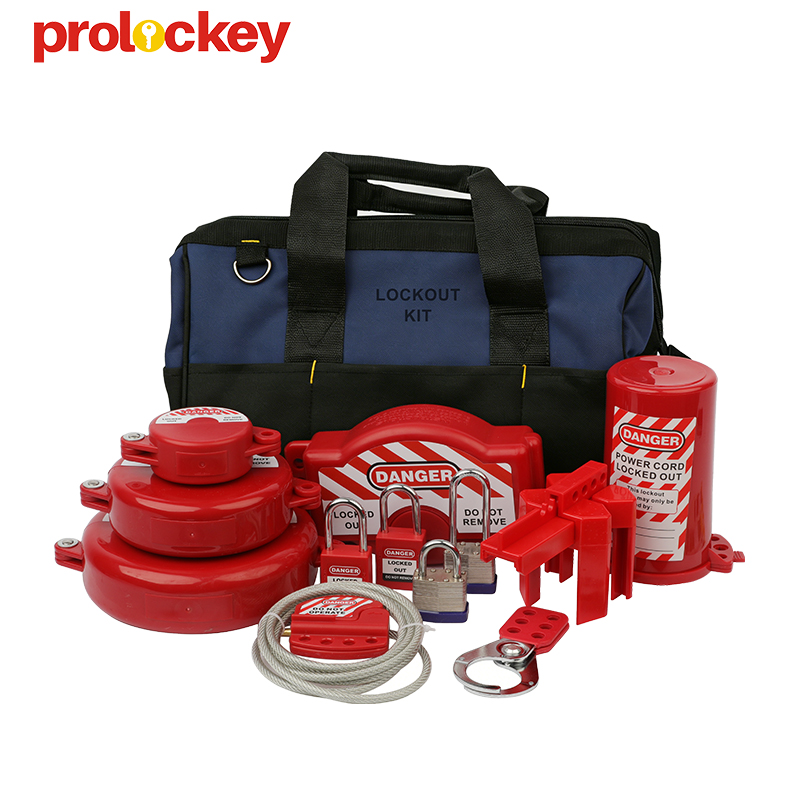
The safety lock is the indispensable first item. It must meet the basic requirements of OSHA 1910.147 regarding “solid, standardized, and identifiable”, and the material should be selected based on the working environment – modified nylon PA6 for electrical maintenance scenarios (insulating and non-conductive), 304 stainless steel for chemical corrosion environments, and fire-resistant aluminum alloy locks for high-temperature or flammable/explosive scenarios. Each lock should have a unique number, a key retention design, and a key number management for the matching keys.
The lock catch is the bridge for group locking scenarios. When multiple workers are involved in the operation, each worker needs to independently lock at their isolation point. A single lock hole cannot accommodate multiple people, so a lock catch (commonly 4-hole, 6-hole, or 12-hole specifications) is needed to achieve “collecting all the keys for everyone to lock” for group protection.
2. Auxiliary locking devices: Adapting to various isolation points
Just having locks and lock catches is not enough, because the shapes of energy isolation points on-site vary.
Valve lockout devices are used for physical isolation of gate valves, ball valves, and butterfly valves. The corresponding specification should be selected based on the diameter of the handwheel (common specifications from one inch to one foot are covered). The handwheel is fixed by a covering structure to prevent accidental operation.
Circuit breaker locking devices are used for electrical isolation. Common types include small circuit breaker lock clips, plastic shell circuit breaker lock clips, and universal circuit breaker lock clips, covering mainstream switch cabinet models.
Plug locking devices are used for the isolation of electrical plugs. The plug is locked by covering it with the shell to prevent it from being reinserted into the socket during the operation.
Cable rope locking devices are suitable for non-standard positions such as the handles of ball valves and butterfly valves, providing a flexible solution.
Whether the tool kit is complete often depends on whether these auxiliary devices cover all the isolation forms on-site.
3. Warning signs and identification system: Turning “locked status” into visible information
The sign is the “language” of the lock.
Warning signs convey three pieces of information through color, pattern, and text: the equipment is in a locked state, who locked it, and why it was locked. The sign must comply with the physical standards of OSHA 1910.145 – waterproof, tear-resistant, readable at a 5-foot distance, fixed on the front, and using eye-catching red and yellow warning colors to allow anyone present to recognize the danger at a glance.
The tool kit should be equipped with an adequate number of blank signs and pre-printed signs, combined with waterproof marker pens or laser etching for identification, to achieve “lock + sign” dual protection.
Post time: Sep-03-2026


