

Universal vs. Adjustable Valve Lockouts: When to Use Each Type
Valves are among the most numerous and most varied isolation points on any industrial site. Gate valves, ball valves, butterfly valves; handwheels, handles, operating levers; sizes ranging from a few centimeters to over a meter across. “Locking a valve” sounds like one task, but what you actually face in the field can look completely different from case to case. To deal with that variety, valve lockouts have evolved into two broad families: universal and adjustable. They lock the same kind of thing, but they work from opposite assumptions — and choosing the wrong one costs you either a lockout that will not fit, or a storeroom full of inventory nobody uses.
Universal Valve Lockouts: Built for Standardization
A universal valve lockout is a single-piece device, typically a shell style or claw style, designed to cover valve handles or handwheels within a certain size range. You slip it over the valve, seat it, attach your padlock — done in one motion.
Its first advantage is speed. No adjustment, no measuring, straight out of the toolbox and onto the valve. On sites with many valves and frequent maintenance, that “grab it and lock it” efficiency adds up to a genuinely substantial saving in working hours.
The second advantage is consistency. Same model, same installation motion, same locking result. Training costs are minimal — a new employee learns it after watching once, and every shift and every crew performs the operation identically. That kind of consistency is itself a goal of safety management.
The third advantage is cost control. With a simple structure suited to mass production, unit cost is usually lower than for adjustable lockouts. When a plant has dozens or hundreds of valves of the same specification, universal lockouts are the most economical choice.
The limitation, though, is just as clear: they only cover the size range they were designed for. A handwheel slightly too small leaves the lockout loose; slightly too large and it will not go on at all. Confronted with a valve outside the range, a universal lockout has no answer — not “barely usable,” but “unusable, period.”
Adjustable Valve Lockouts: Built for Uncertainty
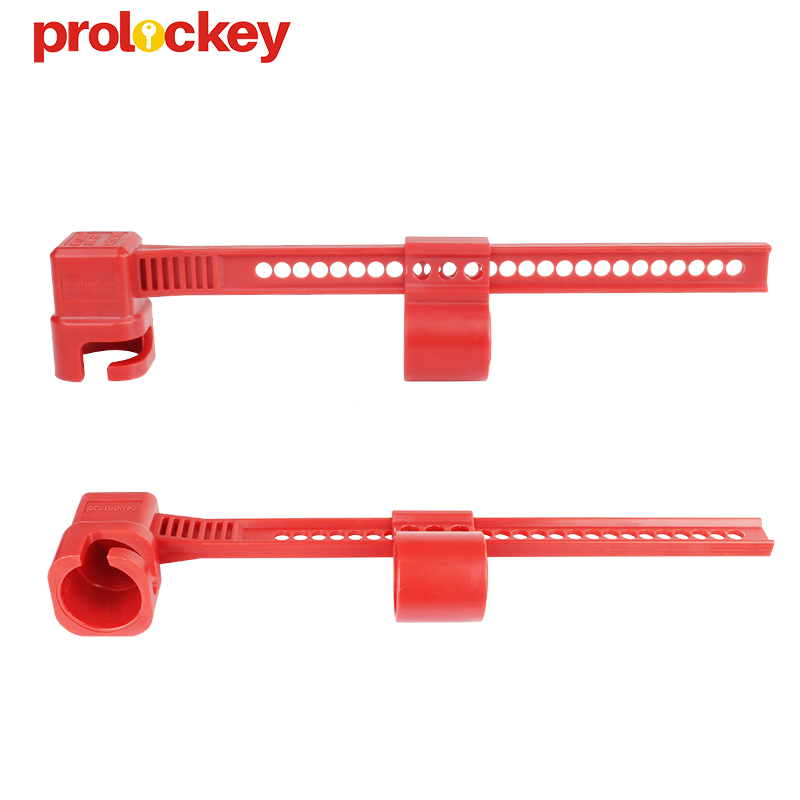
The heart of an adjustable valve lockout is a clamping structure whose opening width can be changed. Through a sliding, rotating, or ratchet mechanism, you adjust the clamping dimension to fit handwheels and handles of different diameters and thicknesses, then secure it with a padlock.
The first advantage is a wide fit range. One adjustable lockout often covers a size span that would take several universal models to handle — from small handles up to large handwheels, one device covers the ground. On sites where valve specifications are not uniform, that value is enormous.
The second advantage is high tolerance for the unexpected. An unfamiliar valve, a modified older machine, a non-standard fixture that appears on no drawing — the adjustability gives you a much better chance of being able to lock it somehow. That tolerance is especially valuable during emergency repairs and when contractors move between sites.
The third advantage is simplified inventory. Rather than stocking a dedicated model for every valve, you cover most situations with a small number of adjustable models. Fewer SKUs means lower management overhead, and fewer problems with expired stock, wrong items picked, or a model that cannot be found.
Its drawbacks sit on the other side of the ledger. Installation is slower than with a universal lockout. Every use means measuring first, then adjusting, then test-fitting, then securing — more steps, more time. On high-frequency jobs that time cost multiplies. On top of that, the adjustment mechanism is itself a moving part, adding one more thing that can loosen, wear, or seize — something a one-piece molded structure simply does not have. And if a moving part works loose under vibration, the lockout becomes decorative.
When to Use Universal
Universal valve lockouts fit these situations:
Sites where valve specifications are highly uniform. If the whole plant runs on two or three valve models with clearly defined size ranges, assigning one universal model to each specification is the cleanest solution.
High-frequency maintenance where efficiency matters. Routine servicing and scheduled overhauls repeat the same motions; the speed of “grab it and lock it” translates into real hours saved.
Standard valves on large installations. Pump discharge valves from the same batch, process line valves from the same series — consistent specifications and high counts are where universal lockouts deliver the clearest economy.
Management systems that demand operational consistency. If you want every person and every shift to perform the installation exactly the same way and minimize human variation, universal lockouts satisfy that requirement by nature.
The test comes down to one question: can you actually count your
Post time: Oct-15-2026


