

Tag Readability: When a Tag Fades, Replace It
1. A Tag You Cannot Read Is a Tag That Does Not Exist
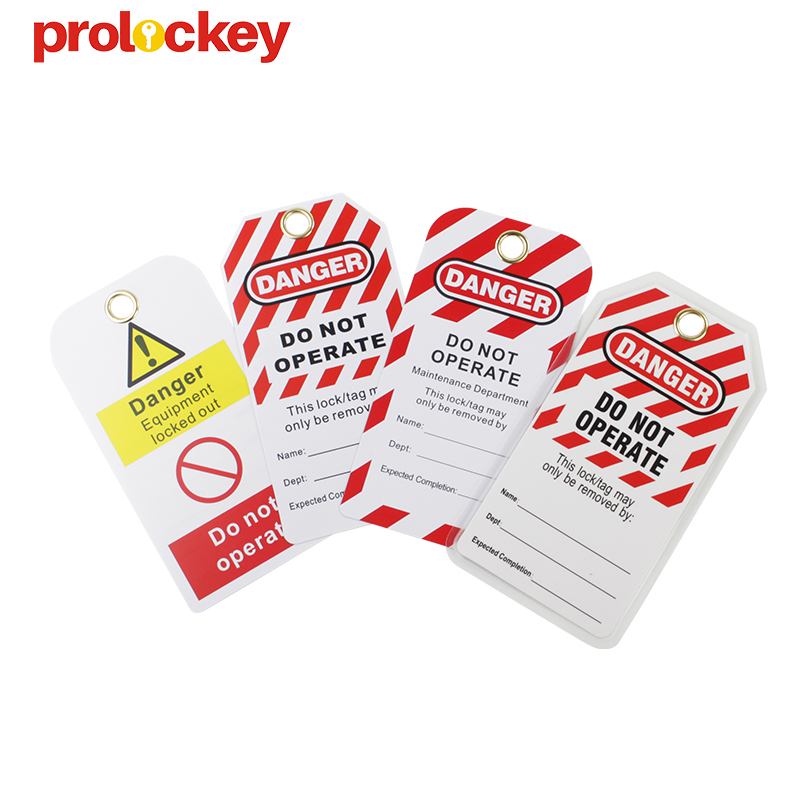
In both lockout/tagout programs and scaffold management, a tag plays a remarkably simple role. It does not block anything, and it does not cut off any energy. Its only job is to make four things clear: what is happening, who is doing it, when it started, and who to contact.
That is precisely where the problem lies. A padlock can rust, but as long as it is still hanging there, it is still physically blocking something. A faded tag, however, can still be hanging in place while the information it carries has already disappeared. At the moment the information disappears, the tag’s safety function drops to zero.
This is why the industry relies on a plain but easily overlooked rule: a tag’s readability is a tag’s effectiveness. If you cannot read it, replace it.
2. Fading Is Not an Accident — It Is Inevitable
Tags used outdoors and on industrial sites begin to degrade almost from the first day they are attached.
Ultraviolet light is the most common culprit. Prolonged sun exposure turns ordinary paper tags pale, breaks down the ink, and washes red and yellow warning colors out to a ghostly pinkish white. From a distance, you simply cannot tell whether this is a danger warning or some routine piece of signage. Chemicals and oil follow close behind. In petrochemical, painting, and machining environments, tags soaked in solvents, cutting fluid, or lubricating oil will smear or blur into an unreadable patch.
Then comes mechanical wear. A tag hanging on a valve handwheel or a cable swings in the wind and rubs repeatedly against metal edges until its corners fray and its lettering is ground away. High temperatures accelerate ink oxidation. Moisture and humidity make paper absorb water, warp, and delaminate. And there is one more cause that is easy to miss: frequent contact with gloved hands and wiping cloths. The act of wiping is itself slowly removing the printed surface layer.
In other words, fading is not evidence of poor tag quality. It is the normal result of the environment doing its work. The real question is whether we have built a mechanism that notices it in time and replaces it.
3. How Faded Is “Unreadable”?
A common question on site is this: the lettering has faded a little — does that count as failure? Does it need to be replaced right now? A workable criterion helps here, rather than relying on gut feeling.
The first category is illegibility in critical fields. On any tag, four pieces of information are core: the danger warning statement, the name of the person in charge, the date of application, and a contact number. If any one of these becomes difficult to read, the tag should be replaced immediately. The reasoning is simple. In an emergency, someone else has to rely on that tag to work out who is still inside the equipment and who to call. One blurred phone number can mean tens of minutes of delay.
The second category is loss of color recognition. Warning tags depend on the high contrast of red and yellow to create the first impression of danger. When the color has faded to the point where it can no longer be distinguished from the background or from an ordinary label, its warning function is gone. Even if the text is still there, the tag should go.
The third category is material degradation. Embrittlement, cracking, curling edges, delamination, or a tie or fastener worn almost to the breaking point — all of these are structural failures. A tag in this condition can fall off at any moment, and once it falls off, all that remains at the isolation point is a padlock of unknown origin. Within a lockout/tagout program, this is one of the most dangerous situations there is: nobody knows who applied the lock, why it was applied, or therefore whether it may be removed.
A simple field test: under normal working light, stand one step back — roughly a meter away — and ask whether you can read the critical information at a glance, without a second look. If you cannot, replace it.
4. Replacement Is an Action, but It Is Also a Mechanism
Spotting the problem is only the first step. What actually determines the level of safety is whether the replacement happens promptly and is documented.
In a lockout/tagout scenario, tag replacement must observe one bottom line: the padlock must never leave the isolation point while the tag is being changed. In practice, this means filling in a new tag completely, with information identical to the original, carrying it to the point of application, verifying it on site, and then swapping it over. Under no circumstances should the lock be removed first in order to change the tag. If the tag information concerns other workers, the person who applied it must be consulted before any change is made. The logic behind this rule is exactly the same as the logic behind “whoever locks, unlocks”: any operation that risks leaving a window in which the isolation is not in place must be prohibited.
In a scaffold scenario, tag replacement is a corrective item arising from an inspection. It is normally carried out by the competent person and recorded in the inspection log. It is worth stressing that the replacement tag must not go up blank. Inspection date, inspector, load rating, and next inspection date all have to be filled in again in full. Simply attaching a fresh, empty tag is not an acceptable substitute.
5. Slowing the Fading at the Source
Replacement is a remedy. Material selection is the cure.
On materials, ordinary paper and coated art paper are fundamentally unsuitable for industrial sites: they disintegrate in water and soak through in oil. Synthetic paper and polyester (PET) film are the mainstream choices. They are inherently waterproof and oil resistant, with high tear strength. Adding a transparent overlaminate on top, or using durable labels designed for thermal transfer printers, significantly slows the rate at which ink is attacked by ultraviolet light and solvents. For tags used outdoors over the long term, a stated UV-resistant rating is worth asking for explicitly.
Writing tools are just as often the weak link. Pencil smudges. Ordinary water-based pens run at the first touch of moisture. Ballpoint pens will not write on an oily surface. Sites should standardize on oil-based marker pens, which dry fast, adhere strongly, and resist water and weathering. The more thorough option is to print tags with a label printer, where the characters and the substrate are effectively one; there is nothing to wipe off. The only thing to confirm then is the weathering rating of the printer ribbon itself.
There is also a low-cost measure that works well: slip the tag into a transparent protective sleeve, or choose a tag holder with a built-in protective window. One extra layer of physical separation can often multiply a tag’s service life several times over.
6. Build Readability into the Inspection Routine
Fading is a gradual process. Relying on “having a look whenever someone remembers” guarantees that some will be missed. Put it on the inspection sheet, and it gets done.
Before each shift, scan whether the tags are still there and still legible. During periodic inspections, make “tag readability” a standalone line item rather than something glanced at in passing. After severe weather, chemical splash, or high-temperature work, add a targeted check. Sites with more mature digital management photograph tags for the record, and the system issues automatic reminders for review on a set cycle, so fading is dealt with long before it becomes failure.
Post time: Oct-20-2026


