

Prolockey Cable Lockout Devices for Large Gate Valves and Oversized Equipment
In the field of lockout/tagout, the hardest things to lock are never the standard ones. Conventional valves have matching valve lockouts. Small circuit breakers have clamp-on lockouts. Plugs have plug lockouts. These isolation points have regular shapes and predictable dimensions — selecting the right device is almost a matter of matching part numbers. The real difficulty shows up when the word “oversized” enters the conversation: a gate valve handwheel over a meter in diameter, a giant butterfly valve spanning an entire pipe rack, an irregular custom fixture, several machines sharing a single operating mechanism. These isolation points either exceed the upper size limit of conventional lockouts or have no standard lock point at all. Every normal “slip it on and clamp it down” approach fails.
Faced with oversized isolation points that cannot be slipped over or clamped onto, Prolockey’s answer is the cable lockout device — a locking solution that uses flexibility to solve a rigidity problem.
Why a Cable: Flexibility Conforms to Irregular Shapes
The core idea behind a cable lockout device is to replace “enclosing” with “wrapping.”
A conventional valve lockout works by having its shell slip over the handwheel and its claws grip the spokes. That requires the handwheel to fall within the lockout’s dimensional range. Once the handwheel exceeds the upper limit, it simply will not go on — no amount of force changes that. A cable lockout works completely differently. A high-strength steel cable can pass through the spoke gaps from any direction, wrap around the outer rim of the handwheel, and return to the lock body to be cinched tight. As long as the cable is long enough, a handwheel of any size can be wrapped.
The first advantage this flexibility brings is nearly unlimited size adaptability. Handwheel diameter, flange outer diameter, operating lever length, irregular structures — if the cable can get around it, it can lock it. The second advantage is spatial adaptability. Narrow gaps, recesses hidden behind piping, operating points on the back side of equipment: a cable bends and threads through, while a rigid shell cannot get in. The third advantage is one device serving many purposes. The same cable lockout can lock a gate valve today, a butterfly valve tomorrow, and a custom fixture the day after — there is no need to buy a dedicated lockout for every single piece of equipment.
The Hard Specifications Behind Prolockey Cable Lockout Devices
Flexibility does not mean weakness. Prolockey’s cable lockout devices are reinforced precisely where it matters.
The cable itself uses a multi-strand stainless steel wire rope construction with a wear-resistant engineering plastic coating. The inner steel wire provides tensile strength; the outer coating protects the surface of the locked equipment from scratches while improving weather and chemical resistance. Cable diameter is a balance between strength and flexibility — too thin and tensile strength suffers, too thick and the cable loses the ability to thread through tight spaces. The entire cable resists UV, oil, and common acids and alkalis, and it holds up in harsh environments such as outdoor pipe racks, damp pump rooms, and chemical plant sites.
On length, Prolockey offers several standard lengths and supports custom lengths on request. The selection principle is practical: measure the circumference of your largest isolation point, add wrapping allowance and working allowance, and that number is the cable length you need. Err on the longer side rather than forcing it short. When a cable is too short, the worst outcome is not that it fails to lock — it is that it cinches down with excessive tension, and both the cable and the lock body fatigue over time under constant high tension.
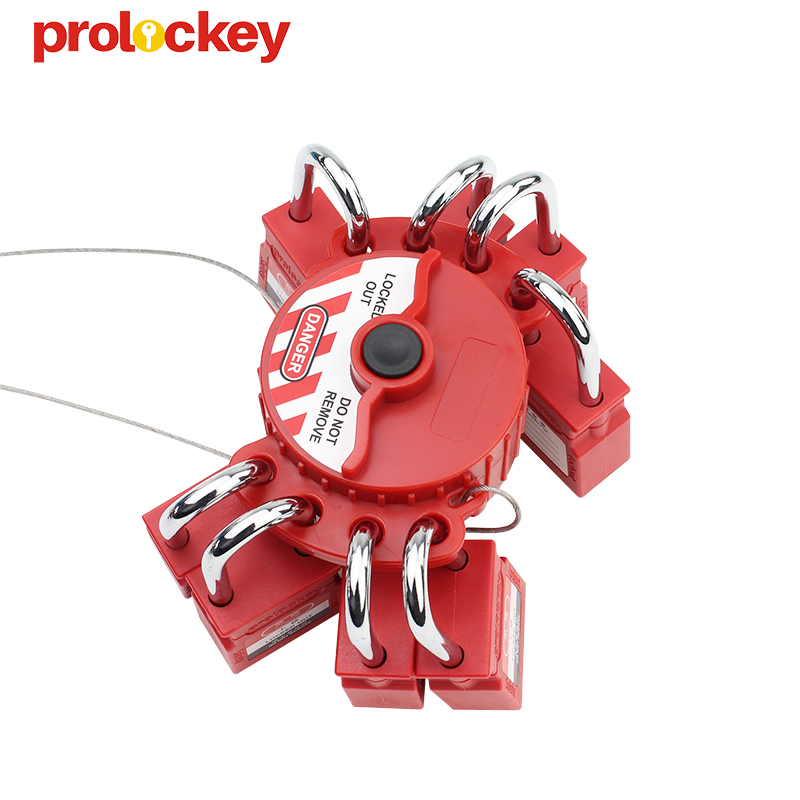
The cable take-up mechanism is the technical heart of the device. Prolockey uses a one-way ratchet tightening structure: once the cable passes through the body, it only gets tighter — it cannot back off. After the cable is cinched to position, the body is locked and the ratchet is immobilized, fixing the cable in place. The significance of this design is that it turns “tightening” into an irreversible physical process. The cable is not held by friction alone; it is locked by mechanical structure.
The lock hole configuration supports group lockout. The body provides multiple padlock holes so each worker can attach their own personal padlock. As long as even one personal padlock remains on the body, the cable cannot be released and the equipment cannot be operated. This matches the underlying LOTO logic that energy can only be restored when everyone agrees. Hole counts are configured to common team sizes, and hole diameters accommodate the shackle diameter of standard LOTO safety padlocks.
On body and color, the main body is injection-molded from engineering plastic — insulating, lightweight, and corrosion-
Post time: Oct-13-2026


