

How to prevent the inadequate implementation of LOTO lockout-tagout procedures and provide a complete solution
The main reasons for the poor implementation of LOTO are divided into four major aspects: employees’ reluctance to do the work and seeking shortcuts, insufficient tool provision, lack of management procedures, and superficial supervision and assessment. Measures that can be implemented in four dimensions – hardware configuration, process standardization, personnel training, and supervision and accountability – are provided:
1. Equip standardized LOTO hardware to eliminate the excuse of “tool shortage”
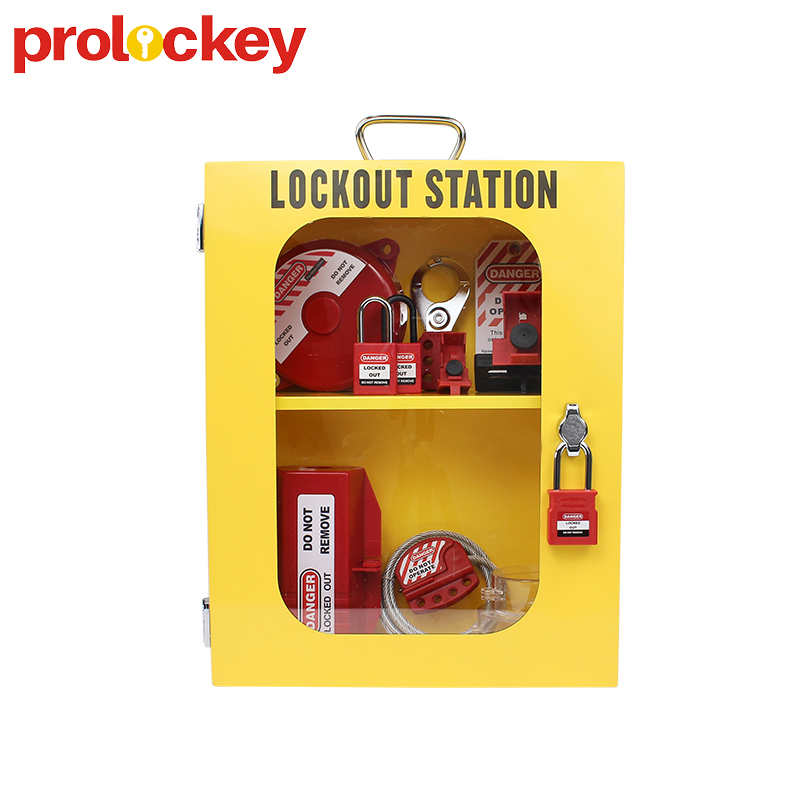
- Configure a Management Lockout Station for centralized lock management
- Install wall-mounted locks in workshops, categorize and store safety locks, extension latches, multi-person row locks, valve locks, circuit breaker locks, warning tags, etc., with clear markings, registration upon retrieval, and return at the end of the shift. Eliminate the objective obstacles such as randomly throwing locks, being unable to find locks, and no additional locking latches for multiple maintenance personnel.
- Standardize the reserved lock positions for equipment
- Install lock holes on all main power switches, gas valves, hydraulic valves, emergency stop main switches; for remote and long-distance energy points, use extended latches locks; there is no need for employees to search for fixed points themselves, and the lock operation is simple and quick.
- One lock per person, color-coded by team
- Each maintenance personnel is issued a unique and exclusive safety lock with a specific code; different workshops or teams distinguish the lock body color; it is strictly prohibited to share, borrow, or privately keep ordinary locks instead of safety locks.
2. Standardize the operation process and reduce simplified operations by hand
- Force the standard five-step LOTO process to be written into the operation card
- Shut down and cut off energy → Isolate electrical / gas / hydraulic energy → Lockout tagout (for multiple maintenance personnel, use extended latches and each person locks independently) → Release residual pressure and energy storage → Test the equipment to confirm that it cannot start before maintenance can be carried out.
- Establish an inspection and confirmation form for maintenance
- Any internal equipment maintenance, cleaning, or debugging must fill out an inspection and confirmation form, indicating the lock positions, lock personnel, and supervisor, and only after signing the unlocking can the equipment be started; without the form, no operation is allowed.
- Mandatory use of multi-lock hole extended latches for multiple-person collaborative maintenance
- When multiple workers are repairing the same equipment, they must use multi-lock hole extended latches to cover the energy switch, each person hanging their own safety lock; all personnel unlock before the equipment can be energized, which fundamentally prevents single-person premature startup.
- Night shift and single-person maintenance must have a supervision mechanism
- For night operations and equipment in confined and enclosed spaces, a site supervisor must be equipped, and the entire Lockout tagout process must be supervised throughout the process; no operation without supervision is allowed.
3. Tiered training + practical exercises to eliminate the fortunately mentality
- Tiered training,rejecting paper lectures
- New employees: Complete LOTO practical teaching,on-site demonstration of locking,unlocking,and multi-person locking process,and only those who pass the assessment can start working;
- Old employees: Monthly safety education and warning,playing cases of crush, electric shock, and mechanical injury accidents caused by not implementing LOTO;
- Managers: Training on supervision and inspection points, understanding and identifying typical violations such as “only pressing the emergency stop without locking”;
- Regular on-site simulation exercises
- Every quarter, organize workshop LOTO practical exercises, simulate equipment blockage maintenance, valve maintenance scenarios, and on-site assess whether employees have completed the lockout-tagout process; correct the behavior of simplifying steps on-site.
- Visual safety publicity
- Post LOTO operation process diagrams and accident warning posters beside the equipment to constantly remind employees not to omit the locking step.
4. Improve the supervision, assessment,and accountability system to form constraints
- Three-level daily inspection mechanism
- Team leaders: Check the implementation of lockout at the beginning and end of each shift;
- Safety officers: Daily inspection of the entire workshop,with key spot checks on night shifts,stamping,injection molding,pressure vessels,etc., high-risk equipment;
- Management personnel: Weekly surprise inspections,focusing on investigating violations such as only pressing the emergency stop,not locking,and not tagging.
- Clearly define the reward and punishment system,strictly handle violations
Positive Incentives: Employees who strictly follow LOTO procedures and actively identify and rectify lockout hazards will be rewarded with performance bonuses;
Severe Penalties: If any of the following behaviors are detected, such as unsecured maintenance, unauthorized removal of others’ safety locks, or using ordinary locks instead of safety locks, the workers will be suspended from work, undergo training, and have their performance deducted; repeated violations will result in job transfers or termination of employment.
Accident Traceability Accountability Mechanism
In the event of an attempted incident or safety hazard, the responsibility of three levels will be investigated: the workers, the on-site supervisors, and the workshop managers. Those responsible for the lack of daily supervision will also be held accountable simultaneously. This ensures that “only punishing the front-line workers” is not allowed.
V. Optimizing On-Site Management, Reducing Operating Costs, and Enhancing Employee Cooperation
Simplify the access process: Lock stations should be placed at nearby locations on each production line, eliminating the need for employees to travel long distances to retrieve locks;
Reduce operation time: All lock points should be standardized uniformly, eliminating the need for additional modifications or bindings;
Collect frontline feedback: Regularly collect difficulties encountered by employees in using extended clasps, lock stations, and lock accessories, and promptly replace the appropriate tools to prevent employees from giving up LOTO due to the difficulty in using the tools.
VI. Long-Term Management Summary
If LOTO is not implemented properly, it cannot rely solely on employees’ self-discipline. The core lies in having complementary hardware, mandatory procedures, practical training, on-site supervision, and penalties for violations. By supplementing the shortcomings with centralized lock stations, extended clasps, etc., and establishing a multi-person interlocking mechanism to strengthen physical protection, combined with inspection and assessment to restrain human violations, it is possible to fundamentally eliminate the behavior of simplifying or skipping the Lockout Tagout process, and prevent accidents such as mechanical compression and electric shock.
Post time: Jun-11-2026


