

Behind every equipment maintenance in the factory, there is a small lockguard protecting the lives of the workers. It is not an ordinary door lock; it is a LOTO (Lockout/Tagout) safety lock – the last physical defense line in the industrial hazardous energy control system. Choosing the right lock means removing the fuse before an accident occurs; choosing the wrong lock may render the entire safety procedure ineffective.
However, when faced with the wide variety of safety padlock products available in the market, many enterprises’ purchasing and safety managers often have no idea where to start: nylon or steel? same pattern or different patterns? long lock frame or short lock frame? These seemingly minor choices actually directly affect the effectiveness and compliance of the LOTO procedure. This article will provide you with a systematic selection guide from dimensions such as material, lock frame, key system, identification management, and compliance standards.
1. Why is the selection of safety padlock so crucial?
The LOTO safety padlock is fundamentally different from ordinary civilian padlocks. The purpose of an ordinary padlock is “to prevent theft”, while the purpose of a safety padlock is “to prevent accidental operation” – to prevent equipment from being accidentally started during maintenance and to prevent dangerous energy from being accidentally released.
An inappropriate safety padlock may result in:
Environmental failure: Using ordinary steel locks in corrosive environments causes the lock body to rust and become unusable, delaying emergency rescue.
Electrical hazard: Using conductive metal lock bodies in electrical operations increases the risk of electric shock.
Management chaos: The design of the key system is improper, resulting in multiple people being able to open the same lock, violating the principle of “one person, one lock, one key”.
Compliance deficiency: Not meeting the standardized and identifiable requirements of OSHA or national standards, and being judged non-compliant in safety audits.
“The core requirement of the LOTO safety padlock is not anti-theft, but anti-unintended opening. Its safety is reflected in three aspects: durability (reliability in the predetermined environment for a long time), specificity (the key is not compatible with ordinary locks, low cross-opening rate), and identifiability (clear and distinct color and markings). ” —— Professional consensus in the field of industrial safety.
2. Lock Body Material: The First Decision Point
The material of the lock body is the first factor to consider when making a selection, as it directly determines the durability, electrical safety, and environmental adaptability of the lock. Currently, the mainstream security locks offer four material options:
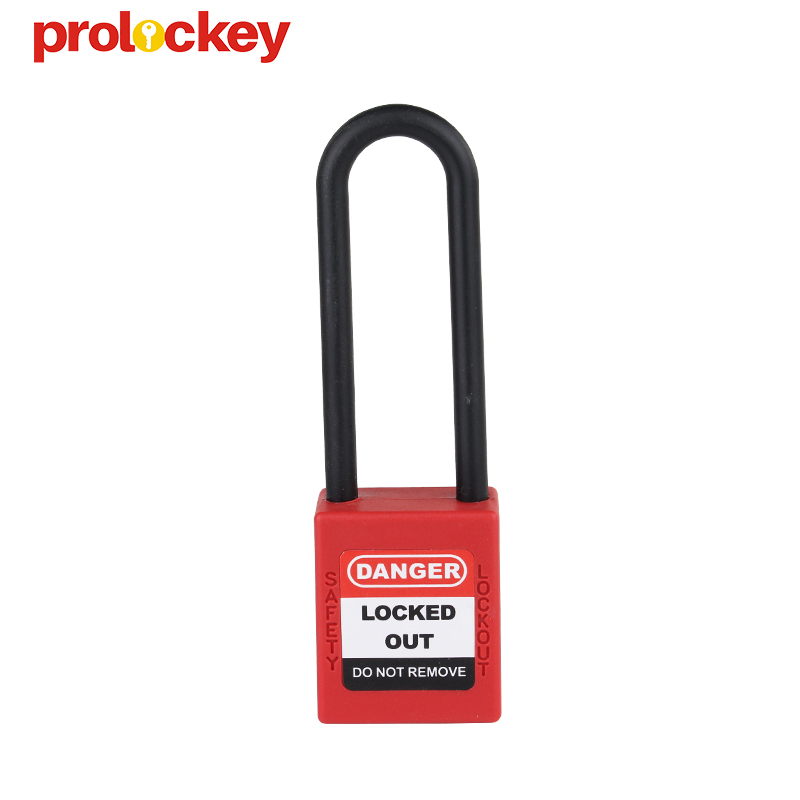
Engineering plastics (nylon/boron fiber reinforced nylon)
Key advantages: Electrical insulation, no sparking, lightweight, corrosion resistance, short customization color cycle
Applicable scenarios:
Electrical equipment maintenance and circuit breaker locking
Isolation of electrical control cabinets and distribution panels
General indoor industrial environment
Scenarios with multiple departments requiring color-coded management
Notes: Under extreme external forces, the shear resistance is inferior to that of metal materials, and it is not suitable for heavy industry environments with high impact.
Post time: Jul-09-2026


