

How to Choose the Right Circuit Breaker Lockout Device
Let me tell you about an incident that occurred repeatedly in the factory: Before conducting electrical maintenance, someone would move the switch of the circuit breaker in the distribution cabinet to the “OFF” position, hang a sign, thinking that this was safe. However, the neighboring team, not knowing that someone was conducting maintenance, came back and simply turned the circuit breaker back on – the equipment suddenly started up, and the maintenance personnel nearly had an accident.
The purpose of the Circuit Breaker Lockout is to change the state from “thought to be turned off” to “no one can turn it on”. However, the problem is that circuit breakers come in a wide variety of shapes and sizes, and the lockout devices have also diversified into numerous types. This article helps you clarify your thinking before purchasing, so that you won’t end up buying something only to find out it can’t be installed later.
First, make sure you understand the circuit breaker.
Before buying the lock, make sure you know which type of circuit breaker you are dealing with. Because different circuit breakers have completely different locking methods.
Miniature circuit breaker (MCB). The most common type found in distribution boxes, with black levers the width of a finger, arranged in rows. This is the easiest type to lock and has the largest number of compatible locks.
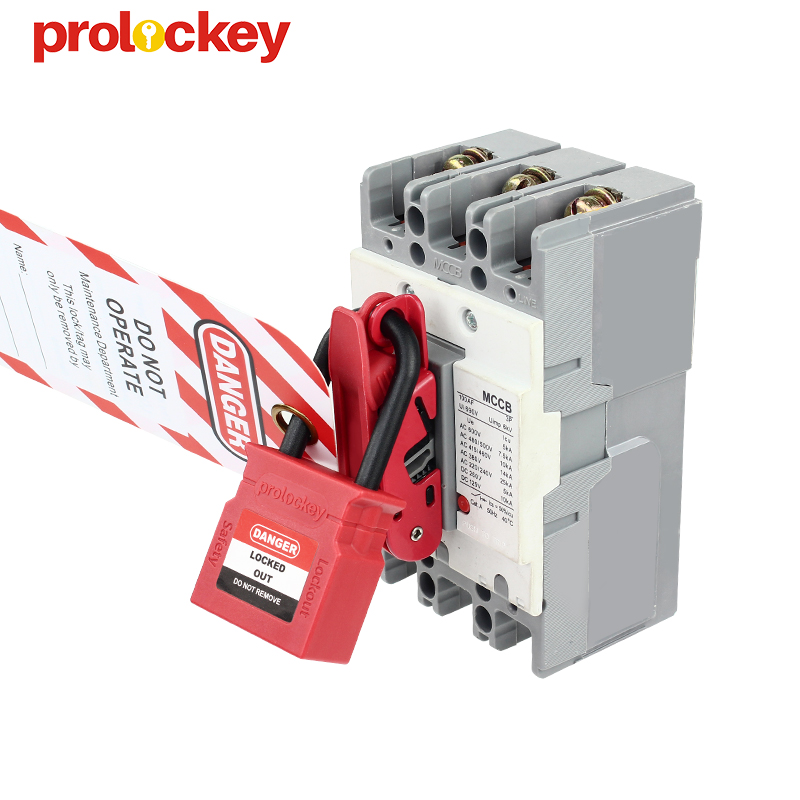
Frame circuit breaker (MCCB). It is larger than MCB, with a wider and thicker handle and a higher current capacity. It is usually used in the main distribution cabinet of the workshop or the power supply circuit of a single large equipment. The lock should precisely match the size of the handle.
Frame circuit breaker (ACB). The largest type, the mainstay of industrial distribution rooms. The handle is quite large, and some of them are not lever-type but rotary handle-type. The locking method is completely different from the previous two types.
Rotary handle circuit breaker. It’s not a toggle switch, but a circular rotary switch that can be operated with a key or a handle. The locking mechanism is to block the rotating mechanism.
Push-button circuit breaker. Some older equipment uses the push-button type. Pressing it down is OFF, and pulling it out is ON. This requires a cover-type lock.
The first suggestion: Go to the front of the distribution cabinet and take pictures of the brand and model of each type of circuit breaker. Clearly capture the shape, width of the handle, and the space beside it. Then, show the photos to the supplier for communication. This is a hundred times more reliable than describing “approximately this wide” over the phone.
Several mainstream types of circuit breaker locks
1. Snap-in type / Clamping type – The easiest type
This type of lock is directly clamped onto the lever of the circuit breaker. When closed, a lock pin is inserted through the lock hole to secure it. Installation does not require tools and can be completed in just a few seconds.
Its principle is quite simple: Once the lever is gripped, the lever cannot move. When released, it becomes stuck, relying on a mechanical dead point.
Applicable objects: Standard width miniature circuit breakers (MCBs), as long as the lever width is around 8-12mm.
What are the limitations? When dealing with extremely wide or extremely narrow levers, they cannot be securely held. Also, for those cases where multiple circuit breakers are placed side by side and there is no sufficient operation space nearby, the clamps cannot be inserted.
2. Snap-in / Pin-through type – For panel-mounted circuit breakers
Some circuit breakers have a small round hole next to the toggle lever, which is specifically designed for locking. Insert a small pin into this hole and secure it with a lock, and the handle will be locked.
Applicable objects: Plastic molded circuit breakers with built-in locking mechanism (MCCB), and some industrial-grade MCBs.
Advantages: Once installed, it is very sturdy and unlikely to be knocked off. Disadvantages: If there is no such small hole reserved on your circuit breaker panel, it won’t be of any use.
3. Rotating Handle Lock – Perfect for Rotating Switches
The structure of the rotating handle is different from that of the lever-type lock. The lever lock cannot be installed at all. The rotating handle lock usually consists of a cover or a clamping ring, which is placed around the handle to prevent it from rotating.
Purchase Focus: The outer diameter and shape of the handle. Some are round, some are flat, and some have keyholes. A difference of just a few millimeters in size will prevent it from fitting. Use a caliper for measurement; do not rely on visual estimation.
4. Enclosed / Box-type – Lockout for an entire row
If several rows of circuit breakers on a distribution cabinet need to be locked out simultaneously, locking them one by one would be inefficient. The enclosed lock is a transparent plastic cover that covers an entire row or group of circuit breakers. It is fastened by a lock after being securely fastened.
Advantages: Locks each piece at once. Precautions: Suitable for distribution boxes where circuit breakers are neatly arranged and have standard spacing. If the circuit breakers in the distribution box are crooked or the spacing is irregular, the cover may not close properly.
5. Universal / Pull-rod type – A last resort option
Some circuit breakers have such strange shapes that none of the standard locks fit. In such cases, the “pull-rod type” or “universal type” Circuit Breaker Lockout can be used – essentially, it is an adjustable locking mechanism. By tightening the screws or pulling the rope, the switch can be locked in the OFF position, and then it can be secured with a padlock.
To be honest, the stability of this type of lock is not as good as that of the specialized ones. It can work, but if you have a better option, it’s better to choose the specialized one. The universal type is the last resort and not the first choice.
Post time: Jul-02-2026


