

Lockout‑Tagout (LOTO) Hasps: Core Hardware for Group Lockout
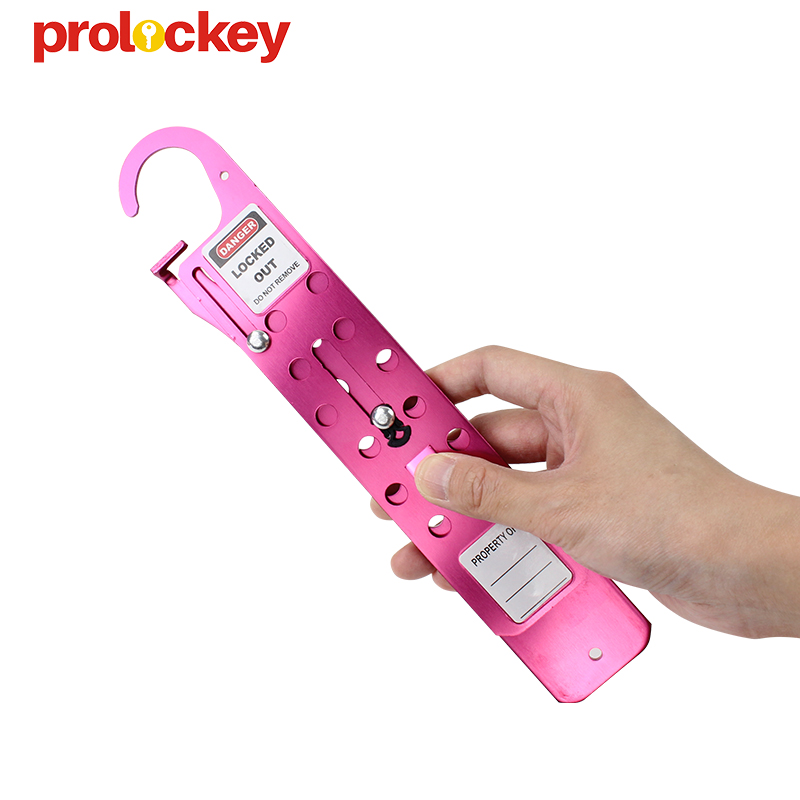
Within the LOTO (Lockout‑Tagout) system, a lockout hasp is the critical hardware for group lockout applications. It is a hinged metal device. One end can be secured onto an energy‑isolation point of equipment, such as a circuit‑breaker handle, valve handwheel or electrical switch. Once closed, the opposite end features a number of lock holes.
The core function of these holes is straightforward: each hole allows one worker to attach their own personal safety padlock.
The operating principle of a lockout hasp is simple. After the hasp is closed and locked, the equipment‑isolating component is physically secured in the closed position. The hasp can only be opened and energy restored to the equipment once every padlock fitted to it has been removed. The more locks attached to the hasp, the more personnel must give consent before unlocking, and the greater the number of workers under protection.
Common Lock‑Hole Specifications for Lockout Hasps
Industrial‑grade lockout hasps on the market range from 4 to 24 lock holes. The mainstream specifications are listed below:
- 4‑hole hasp: The smallest standard size, suitable for minor maintenance tasks or jobs involving only a few workers on a single piece of equipment. Compact and lightweight, it works well for isolation points with confined space.
- 6‑hole hasp: The most widely‑adopted industry standard, covering the vast majority of routine maintenance work. It provides enough positions for a maintenance technician, electrician, equipment operator, team supervisor, plus one or two spare slots. Six holes are generally sufficient for most on‑site teams.
- 12‑hole hasp: An extended‑capacity variant designed for large‑scale maintenance with multi‑person collaboration, such as annual production‑line overhauls and cross‑trade joint operations.
- 24‑hole hasp: The largest common‑use specification, built for major group‑lockout scenarios. It is typically deployed for system‑wide isolation, when an entire production line or plant unit is shut down for overhaul, and every work team involved must place their padlock on the same isolation point.
Scissor‑style hasps are also available. They can be extended segment‑by‑segment to add more locking positions, delivering greater flexibility, with sizes covering 4‑hole to 24‑hole configurations.
An Inviolable Rule More Critical Than Maximum Capacity
While understanding how many workers each hasp can accommodate, you must comply with a non‑negotiable principle in the LOTO system:
One Person, One Lock — Never Share
This rule contains three key requirements:
- Two workers must never share one padlock. A padlock typically comes with a single key. If two workers share the same lock, either worker could remove it without notifying the other. This would leave the second worker exposed to unexpected energy release while they are still working on the equipment. Both OSHA 1910.147 and Chinese standard GB/T 33579‑2017 explicitly require every authorized worker to apply their own personal lock.
- Never attach two padlocks to a single hole. Each lock hole is engineered to fit one padlock shackle only. Forcing two locks into one opening may prevent full closure of the padlocks and compromise locking security.
- No proxy locking. Even close work partners or senior supervisors are prohibited from placing a lock on behalf of another worker. The lock represents the statement: I am on‑site, and I do not approve re‑energization. A lock hung by someone else cannot protect an absent worker.
Accordingly, the number of holes on a lockout hasp is far more than just a capacity rating. Every hole corresponds to an individual worker, a unique key, and an independent commitment to personal safety.
Post time: Aug-27-2026


